The Hague: A temporary park as a testing ground for Binckhorst
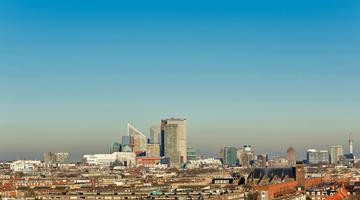
Binckhorst is a former industrial harbor area in The Hague undergoing rapid transformation into a mixed living and working neighbourhood. Over the past few years, approximately 3 500 homes have been built, with a further 1 500 planned. While housing development advanced quickly, public amenities and green space initially lagged behind.
As the population grew to an estimated 7 000 to 8 000 residents, the municipality addressed essential services such as healthcare and retail. However, the absence of accessible green space became a key concern. Although a large waterfront park is planned for implementation from 2028 onwards, an interim solution was needed.
To that end, The Hague aims to bring people and nature together in a public space-based experiment: A wide strip of unused land along a major road, reserved for a future tram line and large buildings, has been converted into a temporary pilot park for a period of at least five years.
The park covers approximately four football fields and has a long, narrow layout. Its design is intentionally nature-based and experimental, giving new residents much-needed green space while providing an opportunity for the City to iterate and adapt its public spaces.

Binckhorst temporary pilot park
The park is also an opportunity to boost local biodiversity: Around 200 trees have been planted with the plan for the area to function as a nursery, allowing for their relocation to other parts of Binckhorst in the future. No seeds have been introduced, enabling observation of naturally establishing plant species. The results will inform the design of the future waterfront park, which is expected to be at least ten times larger. According to Sander Brinkman, Policy advisor for outdoor spaces, Municipality of The Hague: "We let nature go, the space is really nature-based, but we added 200 trees [...] that comprise 11 different species and we are going to monitor how they grow."
The pilot park is also used to study how residents interact with a wilder urban space. Initial observations show that many people walk alongside rather than through the park, raising questions about accessibility, comfort and perception. This sort of observation will be paired with interviews and monitoring techniques from the municipality, to find ways to make the area welcoming and functional, while keeping its rough character. For now, facilities include a playground for children aged 4 to 12, informal meeting areas, a fenced dog field and a quiet memorial space formed by 60 trees. Meanwhile, a nearby school hopes to use the park as an outdoor classroom. The area is already establishing linkages with nearby institutions – a hallmark of a great public space.
Learning through monitoring to shape the future waterfront park
Measuring satisfaction with the pilot park will be undertaken as a collaboration with the municipality's Smart Cities department and project partners, combining interviews, sensor-based data collection and citizen science activities focused on biodiversity. As a temporary space, the pilot park reflects broader transition challenges, including safety, maintenance and social issues typical of areas shifting from industrial to residential use. These aspects are being addressed through coordinated municipal management and gradual programming of activities.
The Binckhorst Pilot Park serves as a testing ground for ecological, social and management strategies. The insights gained will inform the design and operation of the future waterfront park and support broader learning on temporary green spaces in rapidly changing urban areas.
Publishing date: